Keep your POS.Fill your bench.Know your margin.
Service software for independent bike shops. It sits on top of the POS you already run, books work against the hours your techs really have, gets extra work approved in writing, and fills the slow months from your own customer list.
- From $199 a month
- No POS migration
- Starts from a CSV export
Service is the only line that still pays the rent
Product sales stopped covering overhead. The bench is the line with the margin left in it — and it is the line nobody is managing.
- 60%
- Recommended gross margin on serviceagainst about 37% on bikes
- 41%
- Typical operating expensesas a share of revenue
- 4.7%
- Average pre-tax net operating profitacross surveyed shops
- 5 wks
- Late-April tune-up waitthe same job took two days in early March
Sources: NBDA Cost of Doing Business; Jay Townley via Show Daily, 2025.
Four leaks every service department lives with
None of them is a software problem on the surface. All four are revenue walking out of the workshop door.
Capacity rationed by hand
Slots get capped by gut feel — two check-ins a day, Tuesday through Thursday — because nobody can see what the bench can actually absorb next week.
The surprise invoice
A brake bleed quoted at $50 comes back at $95. The work was justified; the conversation never happened, and the review lands anyway.
A customer database asleep all winter
Three weeks out in April, empty in January, with ten to fifteen years of customer and bike records sitting in a POS nobody queries.
Bikes nobody claims
A job stalls, the phone number is wrong or missing, and the bike takes up bench space for months with no record of who was told what.
How a job moves
One job, from the customer's phone to the P&L.
- 01
Before they arrive
The customer describes the problem, adds photos, and picks a drop-off slot the bench can actually keep. No counter round-trip.
- 02
On the bench
The job is booked against real tech hours. When the week fills, intake throttles itself to a waitlist instead of overpromising.
- 03
When the scope moves
A photo and a line item go to the phone. Approve or decline, timestamped. Work on unapproved lines stays blocked.
- 04
After it ships
The job lands in the service P&L — revenue per bay-hour, effective labour rate, quote variance — and the customer joins next winter’s reactivation list.
What the bench actually knows
Two of the numbers CONQRD computes that nobody else in the category does. Both are worked examples, not a shop's results.
- Requested drop-off
- Thu 16 Apr
- Bench load that week
- 94%
- Unassigned tech hours
- 2.5 h
- Jobs already promised
- 31
The counter never offers Thursday, because the bench cannot keep it. Past this threshold intake switches to a waitlist on its own.
- Full suspension service$104
- Drivetrain replacement$88
- Wheel build$71
- Flat repair, walk-in$38
The walk-in flat is below the shop’s loaded cost. Most owners know it in their gut; almost none can put a number on it or say how many they did last month.
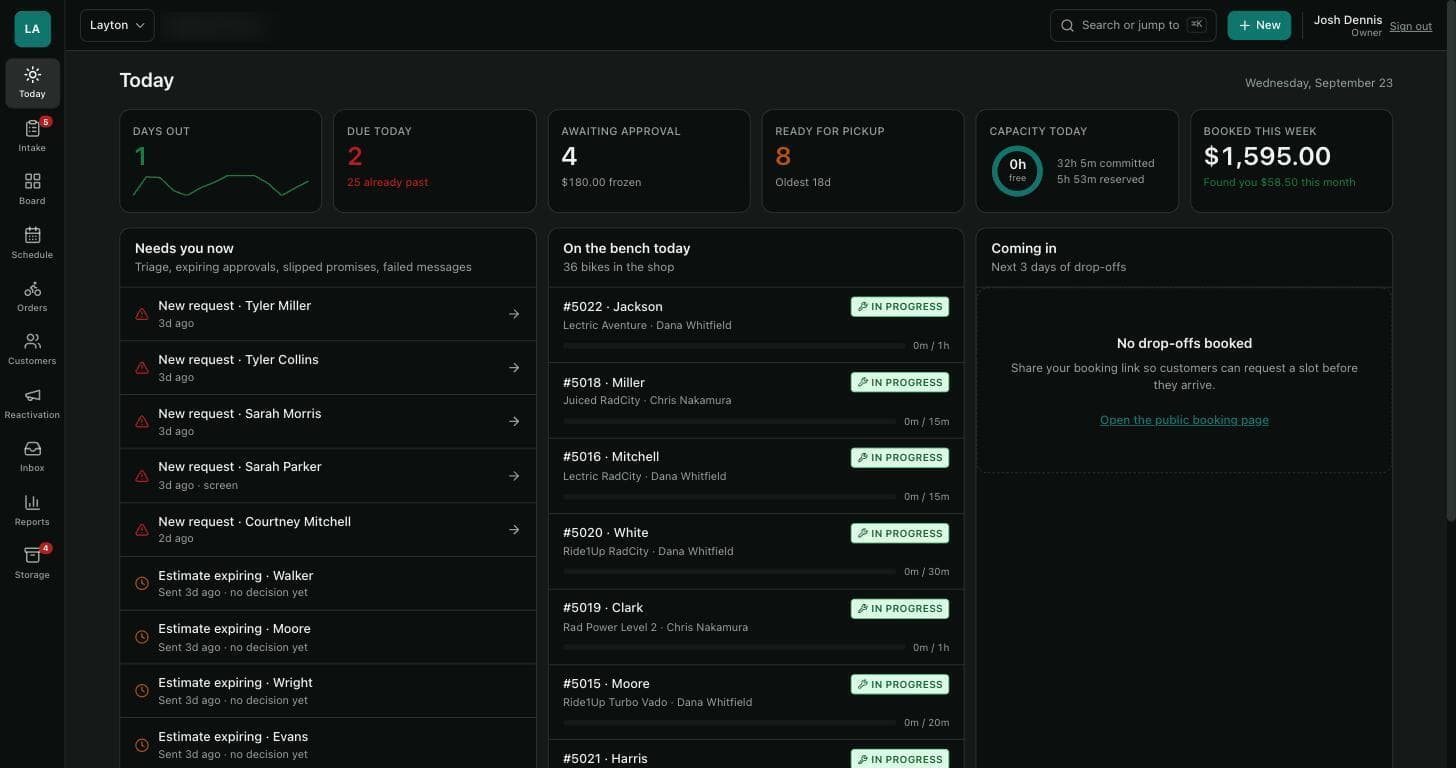
What CONQRD actually does
Five things the rest of the field leaves to gut feel.
Real promise dates
Ready dates computed from tech hours and book times.
Intake throttles itself to a waitlist when you are too far out, so the date you give at the counter is one the bench can keep.
Demand shaping
Season-aware pricing, a paid express lane, and off-season offers.
Pull April work into January instead of turning it away in spring and sitting empty in winter.
Change orders with a paper trail
Photo, line item, approve or decline, timestamped.
Work on unapproved lines is blocked, so the invoice never outruns the conversation.
Reactivation with guardrails
Nightly segments of every customer and bike you have on file.
Campaigns are capped at what the bench can actually service, so a good response never becomes a backlog.
A service P&L
Revenue per bay-hour, effective labour rate, quote variance.
The report that names the jobs losing money, which is the one the owner actually buys.
The field splits three ways, and none of them owns demand
Everyone else manages the work already on the bench. CONQRD manages what fills it, and what it earns.
POS suites
Lightspeed, Ascend, Citrus Lime, Bikedesk
Replace your whole system to get basic service tools.
You migrate the shop to reach a workshop module.
Service bolt-ons
Hubtiger, Velodrop, Bikebook, iKeono
Booking and texting layered onto the POS.
They move tickets. They do not tell you what a January campaign can take, or which jobs you are underpricing.
Paper and whiteboard
Repair tags, a clipboard, voicemail
Cheap, familiar, and it never goes down.
No record of what was approved, no capacity maths, and no trail when a bike goes unclaimed.
CONQRD
The service-department revenue layer. It sits on top of any of the three and manages demand, approvals and margin — so your POS stays the system of record and nobody migrates anything.
Where we are honest with you
- CONQRD is early. We are running pilots, not publishing case studies we do not have yet.
- CSV import works today. Lightspeed, Ascend and Square are built as adapters and are not live yet.
Find out what your winter list is worth
A short call, your own numbers. We will walk the bench through a real week and show you what the quiet months could carry.